
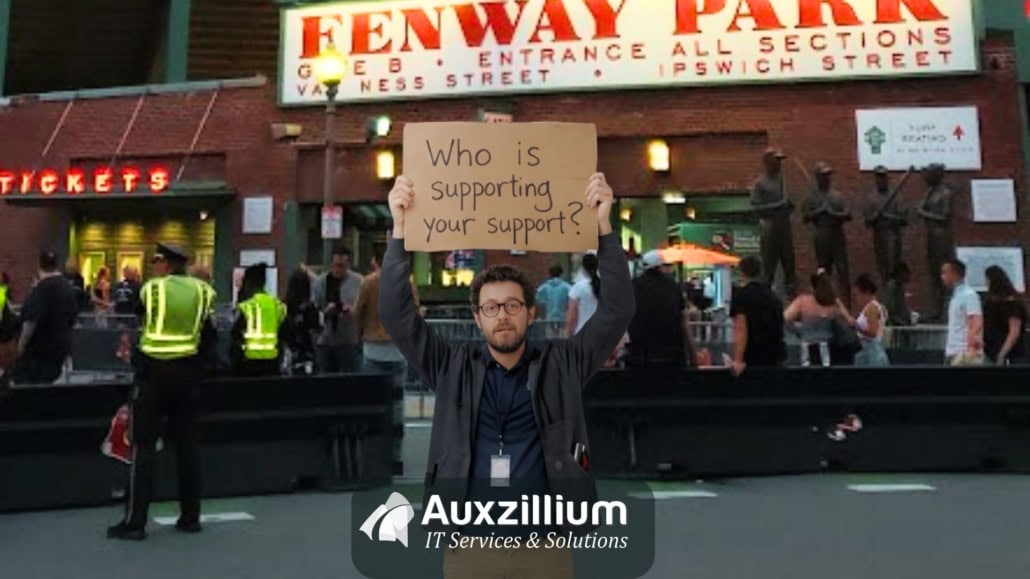
While relying on your Managed Services Provider (MSP) for support is of paramount importance, have you ever asked the question: “Who is supporting them?” If you haven’t then you probably should.
No matter how large of a team or how many years of experience an MSP has, they are not omniscient – they do not know how to solve every problem. They too must rely on support to fill in their gaps of knowledge and experience.
If your MSP provides 24-hour support and offers solutions that carry 9×5 support Monday – Friday, that can do a severe disservice to you and the relationship you have with your MSP. Sometimes, it can be even worse. Some solutions may not even offer telephone support and the only means of contacting them is through email. The problem is exacerbated when you consider that many solutions aren’t US based and stretch across many time zones.
I can remember a conversation I had with one of our hospital’s regarding their chosen eFax vendor. A choice made before Auxzillium’s arrival. eFax was one of the primary ways they received admissions. However, it relied on physical server infrastructure and support only available 7×7 CST. Then, there was an issue on a Sunday w/out a HIPPA compliant workaround. I’m certain you can imagine the conversations that took place afterwards.
The consideration of support is not limited to cloud services and solutions. It should also cover endpoints and any physical infrastructure. Within any technology ecosystem there are certain elements that must be treated with a different level of criticality. In the SMB space, N+1 redundancy for some components can quickly strain the financial budget. This means that mission critical elements should be combined with mission critical support that can mitigate a problem in minutes or hours and not days.
What overarches all of this is the implementation strategy of the solutions deployed across your environment. Is someone “winging it” or was it done according to best practices defined by the vendor?
There is nothing worse than calling a vendor for support of their solution only to find out it wasn’t setup correctly and therefore no support can be offered. That means the problem was self-inflicted and cannot be fixed by your MSP or those supporting them.
These factors in conjunction with how your MSP addresses them go a long way toward shaping how the MSP views the importance of being able to consistently deliver the level of support they promised you when your business signed on the dotted line.
One of the first factors Auxzillium considers when vetting a solution is the support model. It is imperative that the support we receive is not in any way tiered. Auxzillium expects the kind of support from its vendors that it provides to its clients. This is the only way to build a reliable and cohesive support model.
