
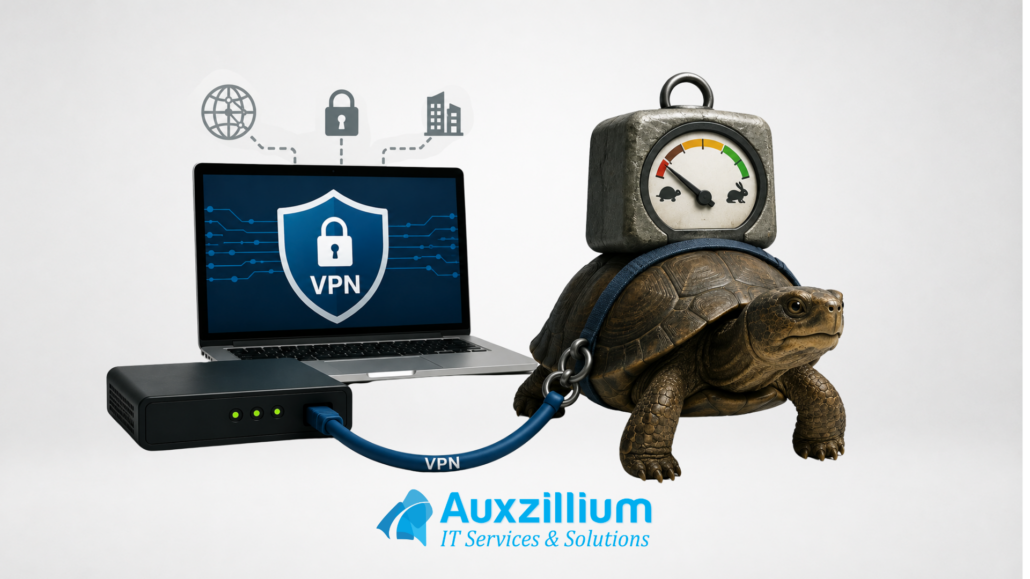
It was only a couple weeks ago I had mentioned the term “teleworker”.
If you have been following these posts you will know that term found its origins when the remote workforce used to use a “tele”phone to dial into their office by way of a MODEM in the days of dial-up. If the term “dial-up” doesn’t make much sense, that term was in reference to the dial on your old phone with numbers 0-9 whereby you call someone, so in the past people would use a dial on a telephone to work remotely. Now, we can move past the history lesson and talk about the modern “teleworker”.
Today, staff may connect to their office or a cloud tenant of some sort where corporate assets/resources exist. Those resources can be databases, files, applications and more. We call this a remote-client Virtual Private Network (VPN). Your staff may just call it a VPN. Today, a proper implementation should include an appliance that services client connections, a directory of some sort containing a list of users and passwords, an agent installed on each user’s endpoint and Multifactor Authentication (MFA) with conditional access policies placing various restrictions on the login attempt.

That’s a lot of resources just to get someone connected. I haven’t even begun to address the assets that exist behind all these resources your users are getting access to. If these resources aren’t cloud-based that’s the first problem since you are still relying on premise-based hardware to run your business, and the modern business has transitioned to cloud-based servers and services. I won’t burn the little time we have here discussing that but if you want, feel free to reach out to a member of the team over here at Auxzillium.
Ultimately, even if your workforce is using a VPN for its workforce to function remotely and the assets they are accessing exist within a datacenter or cloud somewhere the costs are higher, your staff are less efficient, and your approach to Information Technology is behind the curve. Obviously, there are certain circumstances where a VPN must be implemented but that vast majority of businesses using them, do not need to. That includes those requiring a measure of Cybersecurity Compliance.
For quite some time now, the Auxzillium vision has been to be “VPN-less”. I still think we should trademark that term. The first step any service provider should consider when assessing an existing infrastructure that relies on servers rather than cloud-based services is: “What can do I do eliminate all of this and potentially even enhance the current cybersecurity position of my client.”
Most employees hate a VPN. They’re slow, unstable, and need to go down at times when the appliance or resources the VPN has been implemented with and for must be maintained or even renewed. If your business continues to rely on outdated approaches to information technology business solutions, you should definitely reach out to Auxzillium
